
Introduction
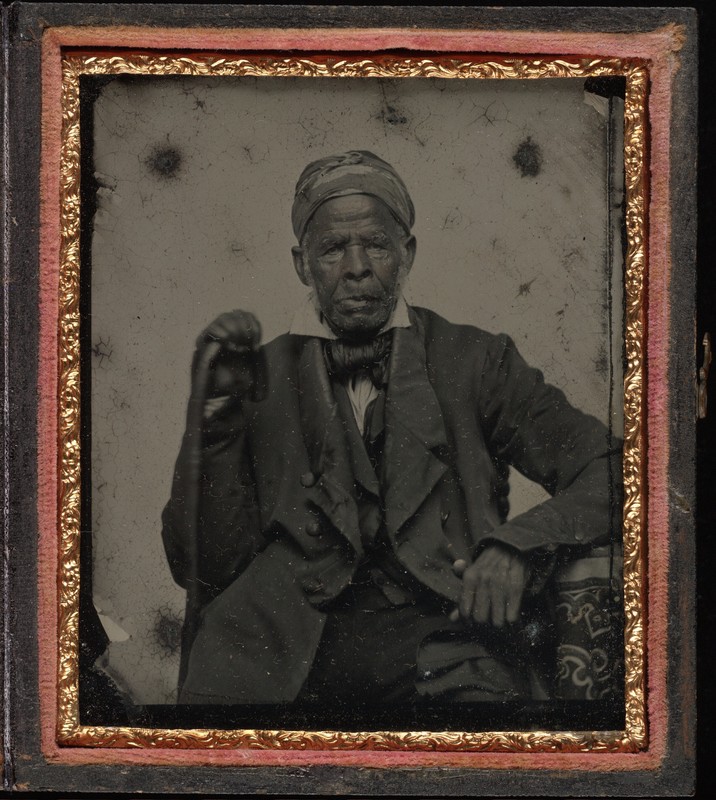
Omar ibn Sayyid
Also known as: Omar ibn Said, Umar Ibn Said, Umeroh, Moro, Omora, Meroh, Moreau, and Uncle Moreau.
(b. circa 1770, d. 1864) Great interest and legend surround the life of Omar ibn Sayyid, an enslaved African man and teacher who lived in the Carolinas in the early 1800s after being captured and sold in his native country of Futa Toro around 1807.
After arriving in Charleston in late 1807, just one month before the importation of slaves was abolished in the United States, Sayyid labored under two different enslavers before managing to escape. He was later captured and arrested in Fayetteville, North Carolina where he was purchased by the Owen family in 1810.
Upon learning Sayyid was highly educated, the Owens moved him to his own cabin, provided access to better meals, and assigned him to work as a type of overseer. The family also purchased a translated copy of the Quran to help Sayyid improve his English.
During this time, Sayyid authored the only known authobiography to be written by an enslaved person in their native language (Arabic) in North America. He is also one of the most documented examples of an enslaved person actively practicing Islam as he authored several surving letters and notations.
The Arabic Bible of Omar ibn Sayyid
The Owens purchased an Arabic translation of the Bible for Omar ibn Sayyid in 1819. James Owen procured the translation with the help of two friends in the American Colonization Society: John Louis Taylor (Chief Justice of North Carolina) and Francis Scott Key (a lawyer and author of “The Star-Spangled Banner.”)
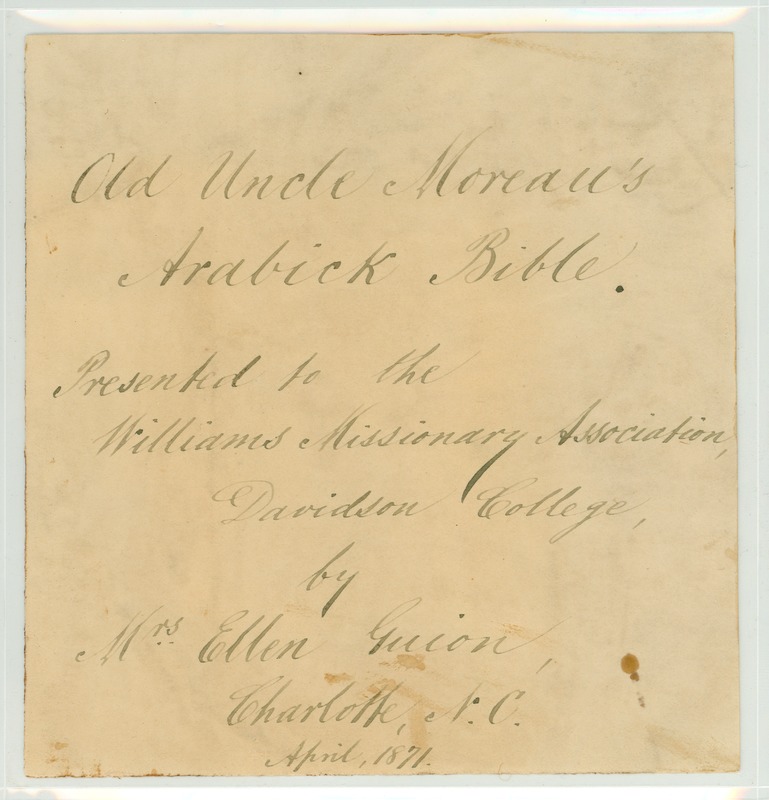
At the urging of the Owens, Sayyid studied the Arabic Bible and attended daily Bible meetings. Sayyid carefully preserved the Bible, covering each worn out cover with new cloth. It is hotly contested whether he ever truly converted to Christianity.
Sayyid's Bible was donated to Davidson College by Ellen Guion, the daughter of Governor James Owen, in 1871 after witnessing the work of Davidson College's Williams Missionary Society. A later donation to the Archives resulted in the addition of two Arabic translations of the Lord’s Prayer written by Sayyid. The Bible is a 1811 Newcastle-upon-Tyne translation into Arabic and features numerous Arabic notations (marginalia) written by Sayyid at unknown dates.
For more information about Omar ibn Sayyid, please consult the Davidson College Archives, Special Collections, and Community blog: "The Autobiography and the Bible: A Tale of Resistance."
Additional resources can be found on our further reading page: Further Reading.