
The Lord's Prayer
It is uncertain how many writings Omar ibn Sayyid penned during his lifetime. Davidson College holds two of these works-- The Bismillah Manuscript and The Al-Fatiha Manuscript. For years they were informally referred to as the blue and brown manuscripts--names derived from the colors of their pages. Both writings feature Arabic translations of The Lord's Prayer. Very little is known about these two documents, including the circumstances surrounding their creation.
"The Bismillah Manuscript"
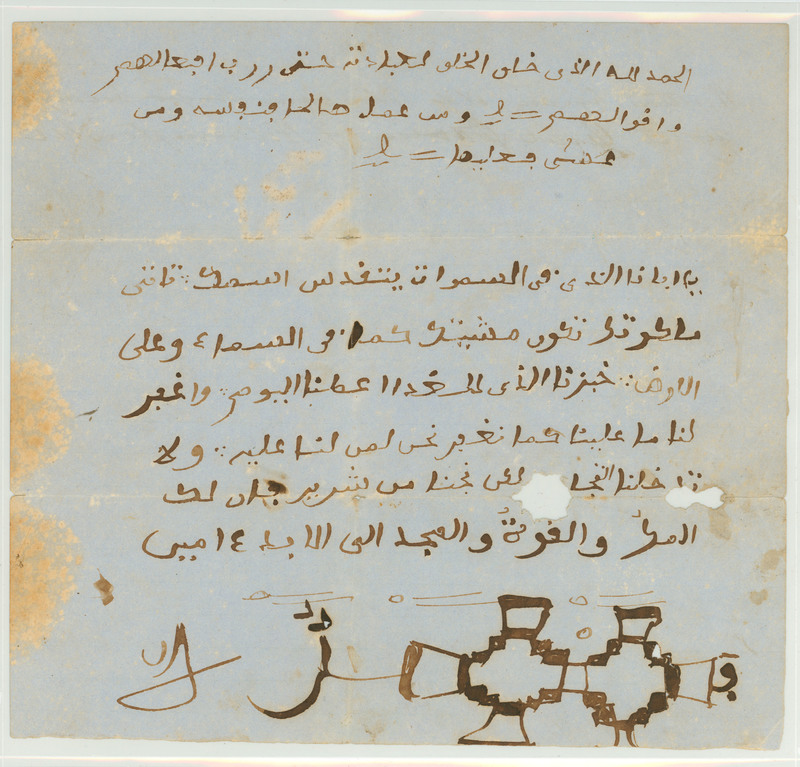

This document was donated to Davidson College in 1963 by James Alvin Riley of Columbia, SC. Mr. Riley believed that his grandfather, Rev. Charles Wilson, obtained the writing while serving the Methodist Episcopal Church near Wilmington, NC circa 1830s-1840s.
The front page features an Arabic translation* of The Lord's Prayer made by Omar ibn Sayyid. The back page features a note believed to have been written by Rev. Charles Wilson as a means of documenting the manuscript's provenance.
Page 1:
The document begins, "Praise be to God who created the world, beyond that for his worshipers." It also includes The Lord's Prayer.
Page 2:
The notation is believed to have been written by Rev. Charles Wilson and reads, "Written by an old African Negro belonging to Genl. Owens of Wilmington, N.C."
*Partially translated by Dr. Jonathan Berkey
"The Al-Fatiha Manuscript"
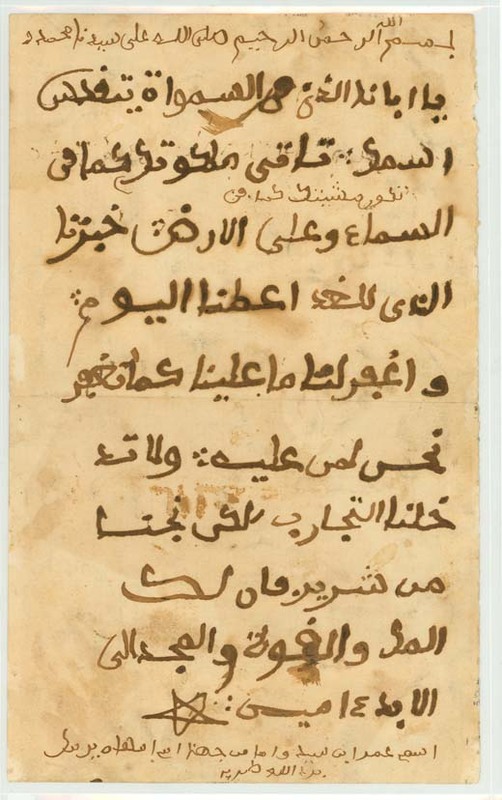
It is uncertain how Davidson acquired this manuscript; however, most agree that it was likely donated to the College along with the Arabic Bible in 1871.This one-page document contains an Arabic translation* of The Lord's Prayer made by Omar ibn Sayyid at an unknown date.
The document begins, "In the name of God the merciful, the compassionate, praise be our lord Mohammed." It also includes The Lord's Prayer and closes with "My name is Omar Ed Sayed."
*Partially translated by Dr. Jonathan Berkey